
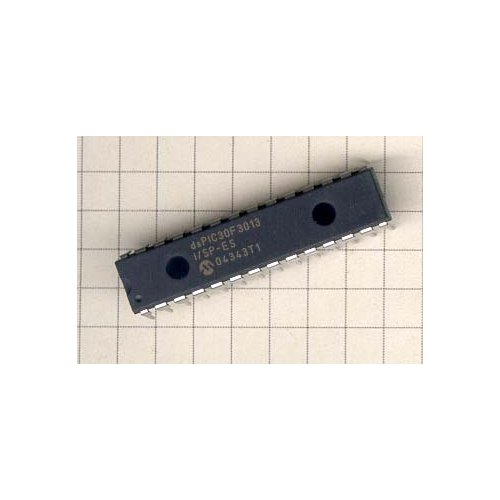
High-Performance,16-bit Digital Signal Controllers
dsPIC30F Motor Control 16-bit Digital Signal Controller. Seamless migration options from this device to dsPIC33F and PIC24 devices in similar packages.
High-Performance Modified RISC CPU:
• Modified Harvard architecture
• C compiler optimized instruction set architecture
• Flexible addressing modes
• 83 base instructions
• 24-bit wide instructions, 16-bit wide data path
• Up to 24 Kbytes on-chip Flash program space
• Up to 2 Kbytes of on-chip data RAM
• Up to 1 Kbytes of nonvolatile data EEPROM
• 16 x 16-bit working register array
• Up to 30 MIPS operation:
- DC to 40 MHz external clock input
- 4 MHz - 10 MHz oscillator input with
PLL active (4x, 8x, 16x)
• Up to 21 interrupt sources:
- 8 user-selectable priority levels
- 3 external interrupt sources
- 4 processor trap sources
• Dual data fetch
• Modulo and Bit-Reversed modes
• Two 40-bit wide accumulators with optionalsaturation logic
• 17-bit x 17-bit single-cycle hardware fractional/integer multiplier
• All DSP instructions are single cycle
- Multiply-Accumulate (MAC) operation
• Single-cycle ±16 shift
• High-current sink/source I/O pins: 25 mA/25 mA
• Three 16-bit timers/counters; optionally pair up 16-bit timers into 32-bit timer modules
• 16-bit Capture input functions
• 16-bit Compare/PWM output functions
• 3-wire SPI modules (supports four Frame modes)
• I2C™ module supports Multi-Master/Slave mode and 7-bit/10-bit addressing
• Up to two addressable UART modules with FIFO buffers
• 12-bit Analog-to-Digital Converter (ADC) with:
- 200 ksps conversion rate
- Up to 10 input channels
- Conversion available during Sleep and Idle
• Programmable Low-Voltage Detection (PLVD)
• Programmable Brown-out Reset
See 0 Ratings & Reviews |
High-Performance,16-bit Digital Signal Controllers
dsPIC30F Motor Control 16-bit Digital Signal Controller. Seamless migration options from this device to dsPIC33F and PIC24 devices in similar packages.
High-Performance Modified RISC CPU:
• Modified Harvard architecture
• C compiler optimized instruction set architecture
• Flexible addressing modes
• 83 base instructions
• 24-bit wide instructions, 16-bit wide data path
• Up to 24 Kbytes on-chip Flash program space
• Up to 2 Kbytes of on-chip data RAM
• Up to 1 Kbytes of nonvolatile data EEPROM
• 16 x 16-bit working register array
• Up to 30 MIPS operation:
- DC to 40 MHz external clock input
- 4 MHz - 10 MHz oscillator input with
PLL active (4x, 8x, 16x)
• Up to 21 interrupt sources:
- 8 user-selectable priority levels
- 3 external interrupt sources
- 4 processor trap sources
• Dual data fetch
• Modulo and Bit-Reversed modes
• Two 40-bit wide accumulators with optionalsaturation logic
• 17-bit x 17-bit single-cycle hardware fractional/integer multiplier
• All DSP instructions are single cycle
- Multiply-Accumulate (MAC) operation
• Single-cycle ±16 shift
• High-current sink/source I/O pins: 25 mA/25 mA
• Three 16-bit timers/counters; optionally pair up 16-bit timers into 32-bit timer modules
• 16-bit Capture input functions
• 16-bit Compare/PWM output functions
• 3-wire SPI modules (supports four Frame modes)
• I2C™ module supports Multi-Master/Slave mode and 7-bit/10-bit addressing
• Up to two addressable UART modules with FIFO buffers
• 12-bit Analog-to-Digital Converter (ADC) with:
- 200 ksps conversion rate
- Up to 10 input channels
- Conversion available during Sleep and Idle
• Programmable Low-Voltage Detection (PLVD)
• Programmable Brown-out Reset