
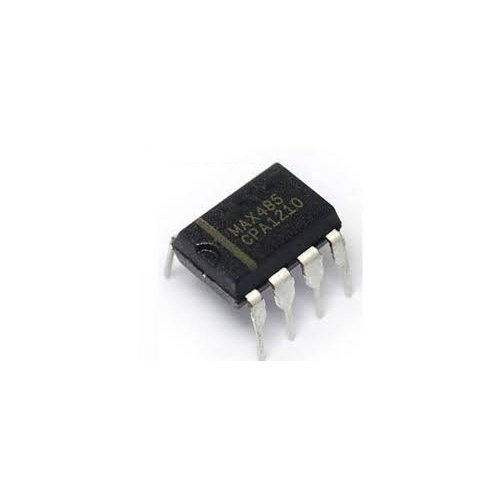
The MAX485 is low-power transceiver for RS-485 and RS-422 communication.
Each part contains one driver and one receiver. The driver slew rates of the MAX485 is not limited, allowing them to transmit up to 2.5Mbps. All parts operate from a single 5V supply.The driver is short-circuit current limited and protected against excessive power dissipation by thermal shutdown circuitry that places the driver outputs into a high-impedance state. The receiver input has a fail-safe feature that guarantees a logic-high output if the input is open circuit. The MAX485 is designed for half-duplex applications.
In µMAX Package: Smallest 8-Pin SO
Low Quiescent Current: 300µA
-7V to +12V Common-Mode Input Voltage Range
Three-State Outputs
Half-Duplex Versions Available
Operate from a Single 5V Supply
Low-Power RS-485 Transceivers
Low-Power RS-422 Transceivers
Level Translators
Transceivers for EMI-Sensitive Applications
Industrial-Control Local Area Networks
Current-Limiting and Thermal Shutdown for Driver Overload Protection
See 0 Ratings & Reviews |
The MAX485 is low-power transceiver for RS-485 and RS-422 communication.
Each part contains one driver and one receiver. The driver slew rates of the MAX485 is not limited, allowing them to transmit up to 2.5Mbps. All parts operate from a single 5V supply.The driver is short-circuit current limited and protected against excessive power dissipation by thermal shutdown circuitry that places the driver outputs into a high-impedance state. The receiver input has a fail-safe feature that guarantees a logic-high output if the input is open circuit. The MAX485 is designed for half-duplex applications.
In µMAX Package: Smallest 8-Pin SO
Low Quiescent Current: 300µA
-7V to +12V Common-Mode Input Voltage Range
Three-State Outputs
Half-Duplex Versions Available
Operate from a Single 5V Supply
Low-Power RS-485 Transceivers
Low-Power RS-422 Transceivers
Level Translators
Transceivers for EMI-Sensitive Applications
Industrial-Control Local Area Networks
Current-Limiting and Thermal Shutdown for Driver Overload Protection